Learning Transferable Visual Models From Natural Language Supervision
Jointly training an image and text encoder to predict which captions match which images (natural language supervision) can create a general-purpose vision model.
CLIP
- In traditional computer vision a large-scale dataset of images was created, each image was labeled with a category (e.g. dog, plane, etc.), and a model was trained to classify the images
- However, there were three issues:
- Labels are expensive
- The model only learns the predefined categories
- The model struggles with new concepts
- The core idea of CLIP is learning visual representations from text paired with images
- It is much easier to scale natural language supervision compared to standard crowd-source labeling for image classification
- Methods which work on natural language can learn passively from the supervision contained in the vast amount of text on the Internet
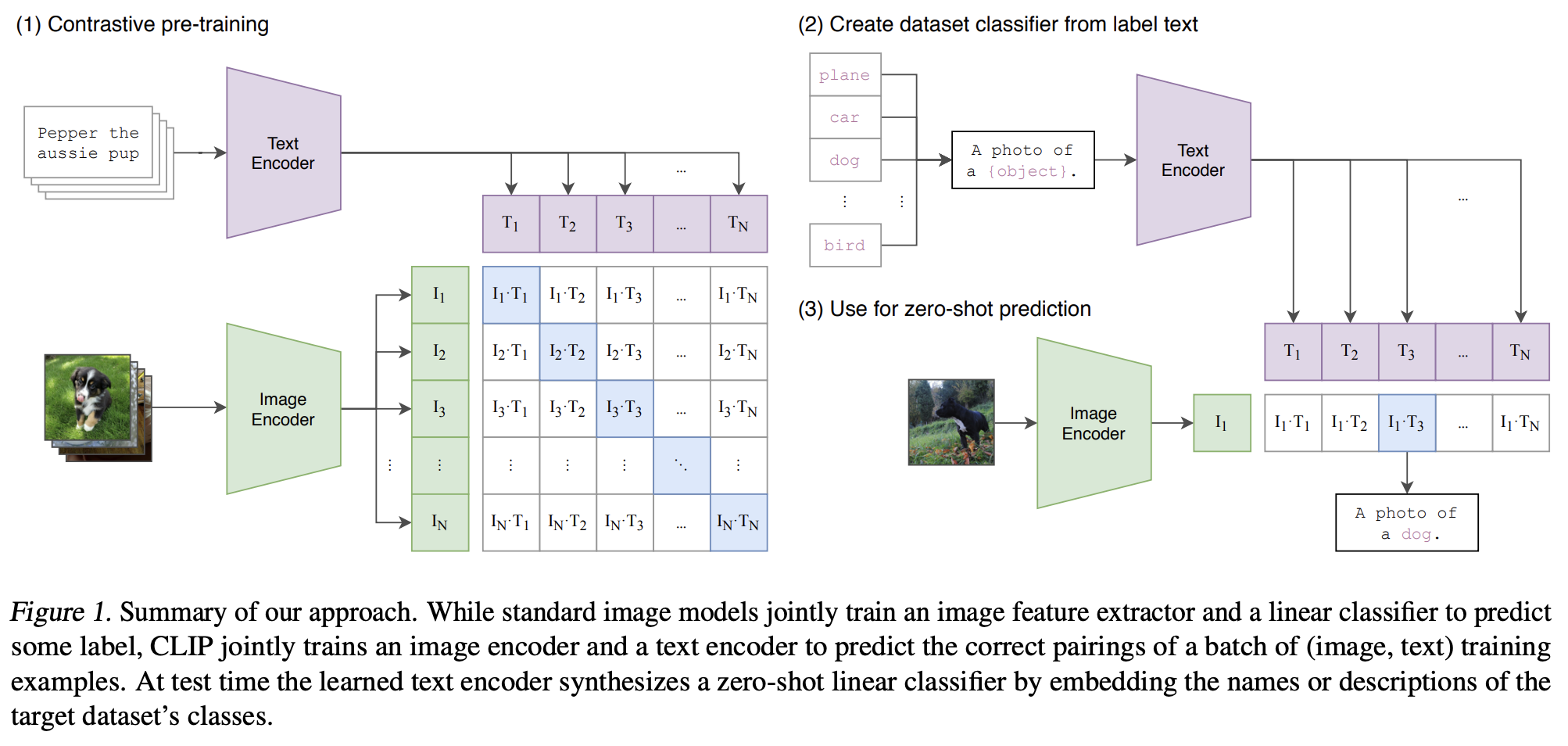
Pre-Training
- Given a batch of $N$ (image, text) pairs, CLIP is trained to predict which of the $N \times N$ possible (image, text) pairings across a batch actually occurred
- CLIP learns a multi-modal embedding space by jointly training an image and text encoder to do two things:
- Maximize the cosine similarity of the image and text embeddings of the $N$ real pairs in the batch while
- Minimize the cosine similarity of the embeddings of the $N^2 - N$ incorrect pairings
- The image encoder is a ResNet or a Vision Transformer and the text encoder is a Transformer
Zero-Shot Classification
- The most famous result from the paper is that CLIP can classify images without being trained on those classes of images
- If we want to classify an image as either A, B, or C we would create three captions:
- “A photo of A”
- “A photo of B”
- “A photo of C”
- Note: We use these captions to remain in distribution of captions on the Internet which often take the form of “a photo of ___”
- We would encode image into $X$ and compute the similarity between $x$ and each caption before taking the caption with the highest similarity
Conclusion
- CLIP was critical in bridging the gap between image and language into a shared semantic space
- Breakthrough: if you train a vision model on enough text-image pairs, language becomes an interface for visual understanding